
If legend is to be believed, the multi-billion-dollar global silk industry owes its existence to a single, delightfully serendipitous cup of hot tea. Around 2700 BCE, fourteen-year-old Chinese Empress Leizu was lounging under the leafy canopy of a white mulberry tree when a papery cocoon tumbled from the branches, landing into her imperial tea. As the steaming liquid loosened the cocoon’s natural gum, a shimmering, endless strand began to unravel. Leizu pulled at the thread, winding it around her fingers and in doing so, unspooled the birth of sericulture.
What tumbled into her cup was the work of Bombyx mori, the domesticated mulberry silkworm with a surprisingly diva-like disposition. Through thousands of years of selective human breeding, this creature traded away its wild survival instincts for pure textile perfection: adult moths are entirely blind, flightless, and lack mouthparts altogether, living only a few days to mate. Their larvae are equally fastidious, demanding a sterile environment kept at precise temperatures and refusing to eat anything other than freshly chopped white mulberry leaves around the clock.
What’s striking about the legend is that it already features a domesticated silkworm (Bombyx mori)—a subtle nod to the fact that sericulture had been quietly developing for centuries.
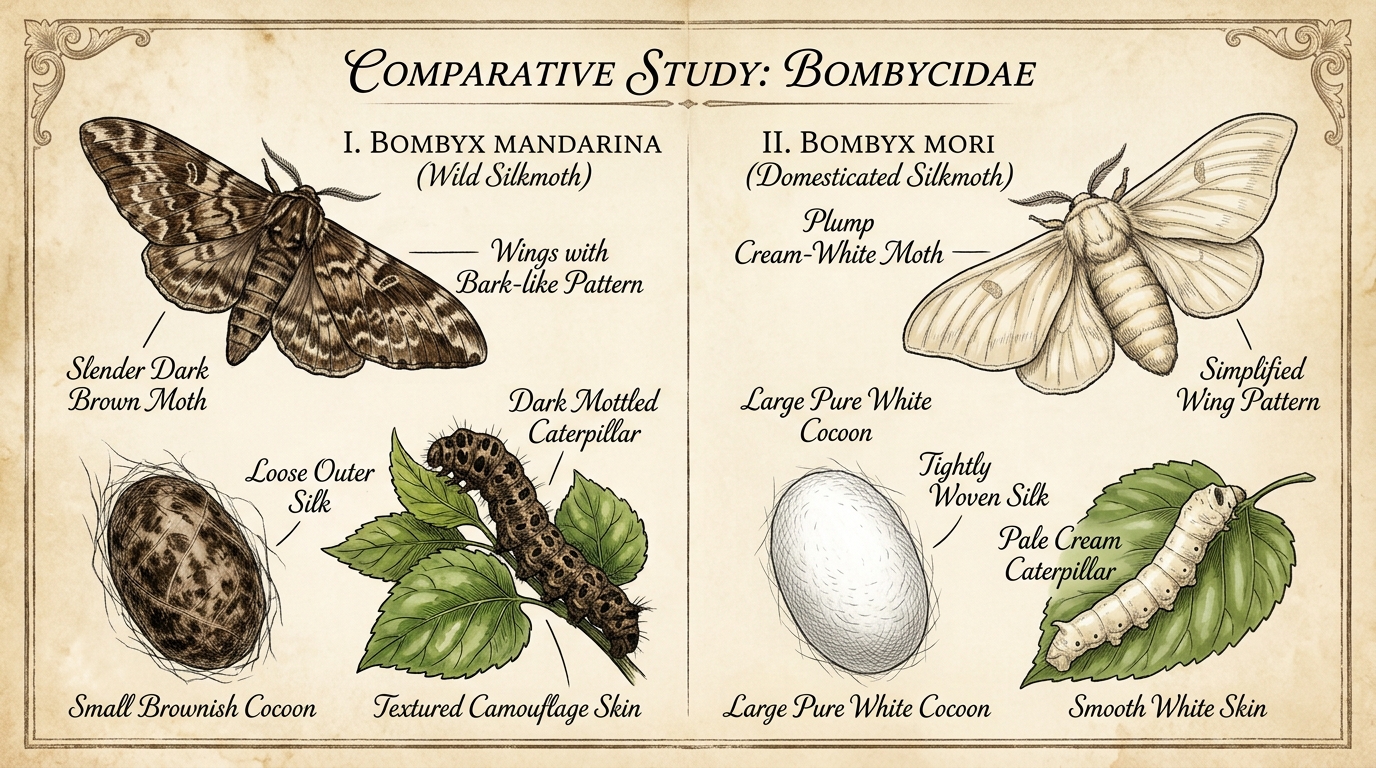
A room of feeding silkworms sounds like steady rain on roof tiles. The larval stage runs about 30 to 35 days, broken by four molts where the worm stops eating for a day at a time. In that period a single silkworm multiplies its body weight 10,000 times.
Then it stops eating altogether. Over the next two to three days it swings its head in a figure-eight roughly 300,000 times, extruding fibroin from modified salivary glands and coating it in sericin. The filament hardens as it leaves the spinneret. One cocoon holds up to 1.5 km of it — of which 600 to 900 m is reelable.
FunFact: the silkworm’s “junk food” diet
While Bombyx mori is famous for its strict white mulberry diet, it isn’t the only silk-spinner in the kingdom, nor is it entirely incapable of eating other greens in a pinch. Wild species like Antheraea paphia (which produces coarse, golden Tussah silk) feed on oak leaves, while the Samia cynthia moth feeds on castor oil plants to produce heavy Eri silk.
Even domesticated Bombyx mori can technically survive on backup alternatives like Osage orange leaves, lettuce, or even beetroot leaves! However, there is a catch: feeding a silkworm anything other than fresh white mulberry leaves is the textile equivalent of putting low-grade fuel into a Ferrari. The resulting silk filament loses its iconic tensile strength, turns brittle, loses its pearlescent luster, and yields uneven, discolored threads. To get that liquid-gold Italian finish, only pure mulberry leaves will do.
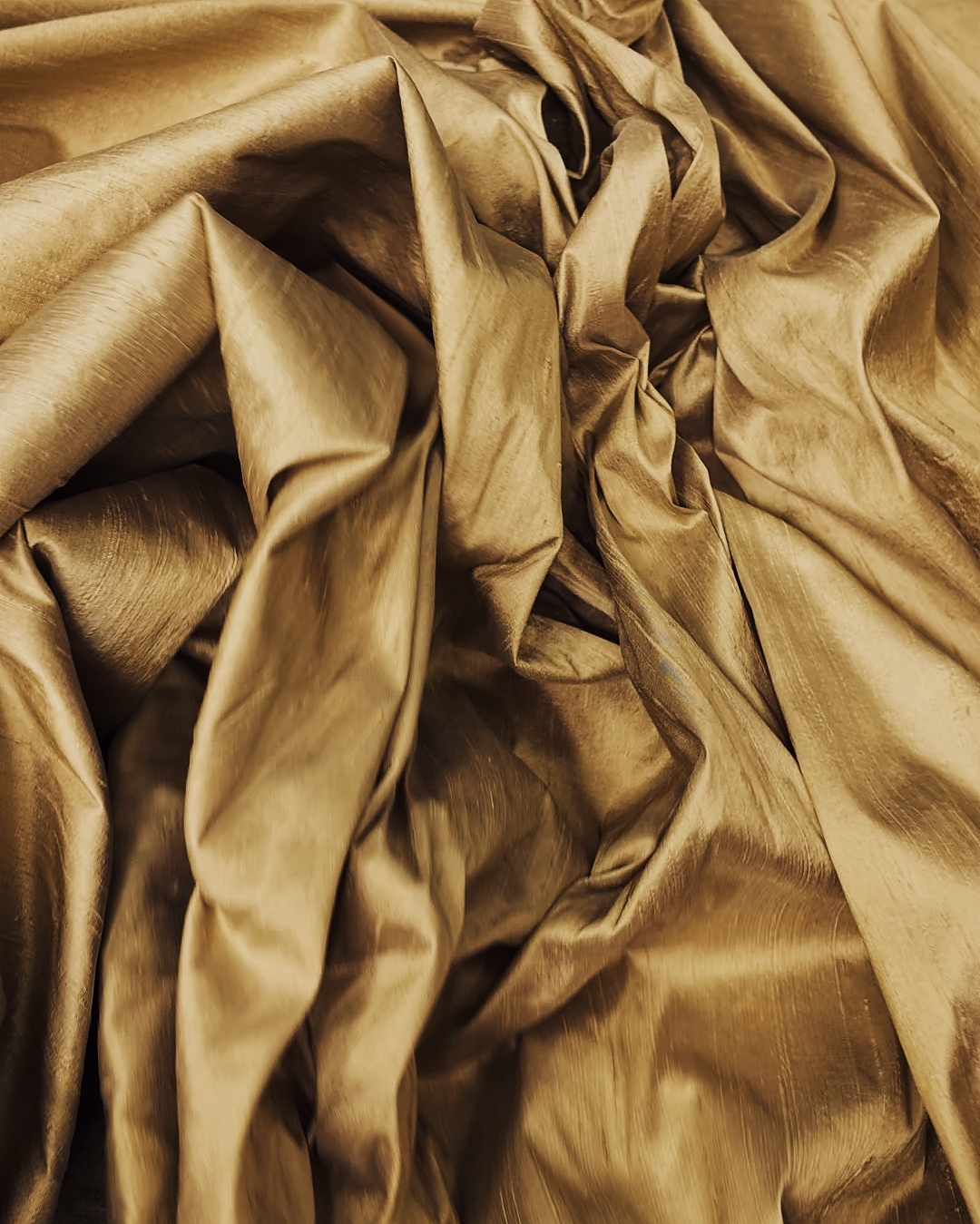
Golden wild Tussah silk raw fabric
Unraveling the secret: The original Industrial Espionage
For over two millennia, Imperial China held an ironclad, state-enforced monopoly on silk production. The secret was guarded with lethal seriousness: attempting to smuggle silkworm eggs, mulberry seeds, or production secrets across the border was a crime punishable by immediate execution. Silk became far more than a textile, it was an international reserve currency, diplomatic leverage, and the ultimate status symbol woven along the dangerous desert tracks of the Silk Road.
By the 1st century BCE, Rome’s elite had become hopelessly, recklessly obsessed. Silk garments were literally worth their weight in gold. Pliny the Elder famously fumed in his writings that the imperial treasury was bleeding more than 100 million sesterces annually to fuel Rome’s addiction to sheer, body-hugging silk gowns. Moralists decried the fabric for exposing the body while technically covering it, while politicians panicked over the economic drain. Yet, despite their obsession, Romans remained delightfully clueless about its origins, genuinely believing the gossamer fabric was spun from a delicate, fluffy tree-down harvested from the tops of trees in distant Asian forests.
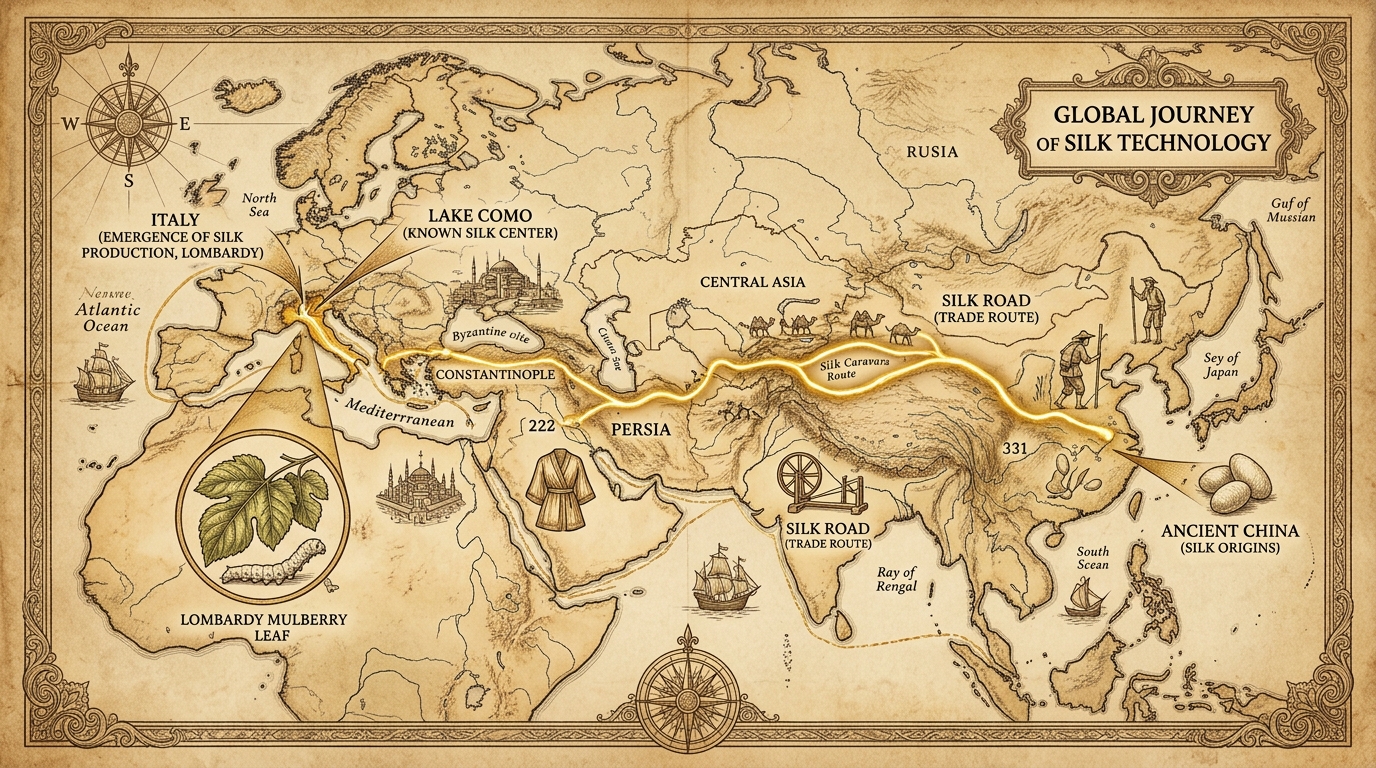
The ancient world’s best-kept secret finally unraveled in 552 CE in what remains history’s most successful act of industrial espionage. Commissioned by Byzantine Emperor Justinian I, who was tired of paying exorbitant Persian tariffs for trade routes, two Nestorian monks undertook a covert mission. Posing as pilgrims, they managed to steal live silkworm eggs and mulberry seeds from China, hiding them inside the hollowed-out centers of their bamboo walking sticks.
The eggs survived the arduous, months-long trek back to Constantinople, where Justinian immediately established imperial workshops. The monopoly was shattered, triggering a centuries-long westward migration of silk production through Persia, Moorish Andalusia, and eventually into the fertile valleys of Northern Italy.
How Italy took the thread and ran with it
If China gave birth to silk, Italy taught it how to dress for high society.
The story of Italian silk began in the South, brought to Sicily by Moorish traders in the 9th century. But it was in the wealthy city-states of the Renaissance North – Lucca, Venice, Florence, and Genoa, that silk weaving blossomed into an elite art form. Lucca became Western Europe’s first true silk capital, producing intricate damasks and brocades that adorned popes, kings, and wealthy merchants. When political turmoil struck Lucca in the 14th century, master weavers fled across Northern Italy, spreading their prized techniques like seeds in fertile soil.
The real industrial turning point came in the late 15th century thanks to Ludovico Sforza, Duke of Milan (famously known as Il Moro). Recognizing the economic power of textiles, Sforza issued a sweeping royal decree that mandated the planting of white mulberry trees across the entire Duchy of Lombardy. The landscape transformed almost overnight, laying the agricultural groundwork for a regional silk empire.
The historical evolution of silk mastery:
- 2700 BCE (China – Origin): Sericulture Secret & Imperial Monopoly
- 552 CE (Constantinople): Smuggled Eggs & Byzantine Imperial Workshops
- 15th Century (Lombardy / Como): Agricultural Mandate & Jacquard Weaving
- 21st Century (Global Sourcing): Master Italian Finishing
Nestled at the foot of the Alps, the Lake Como region emerged as the undisputed crown jewel of Italian silk. It had the ultimate natural recipe for textile production:
- Pristine Alpine Water: The deep, mineral-pure waters of Lake Como and surrounding mountain streams were ideal for the delicate processes of degumming, washing, and vibrant dyeing.
- Early Industrial Ingenuity: By the 16th and 17th centuries, the region adopted water-powered spinning mills, revolutionizing production long before the Industrial Revolution swept the rest of Europe.
- The Jacquard Revolution: In the 19th century, Italian workshops eagerly embraced the Jacquard loom, allowing weavers to translate complex hand-drawn artwork directly into woven silk textiles.
Fun Fact: From Silkworms to High Fashion Mastery
Up until the mid-20th century, the countryside around Como was filled with mulberry trees, and local families actively raised silkworms in their attics. However, after World War II, as European labor costs soared, Italy made a brilliant strategic pivot: they phased out the labor-intensive farming of cocoons and shifted focus entirely to high-end processing, printing, and finishing.
Today, raw unspun silk (greige) is imported primarily from Asia, but it travels to Como for its final, crucial transformation. The famous Italian appretto—a closely guarded recipe of washing, softening, and finishing treatments—is what gives Italian silk its buttery hand-feel, rich drape, and unmatched color depth. Today, the Como district still produces over 80% of all silk ties and scarves used by top global luxury houses like Hermès, Chanel, and Gucci.
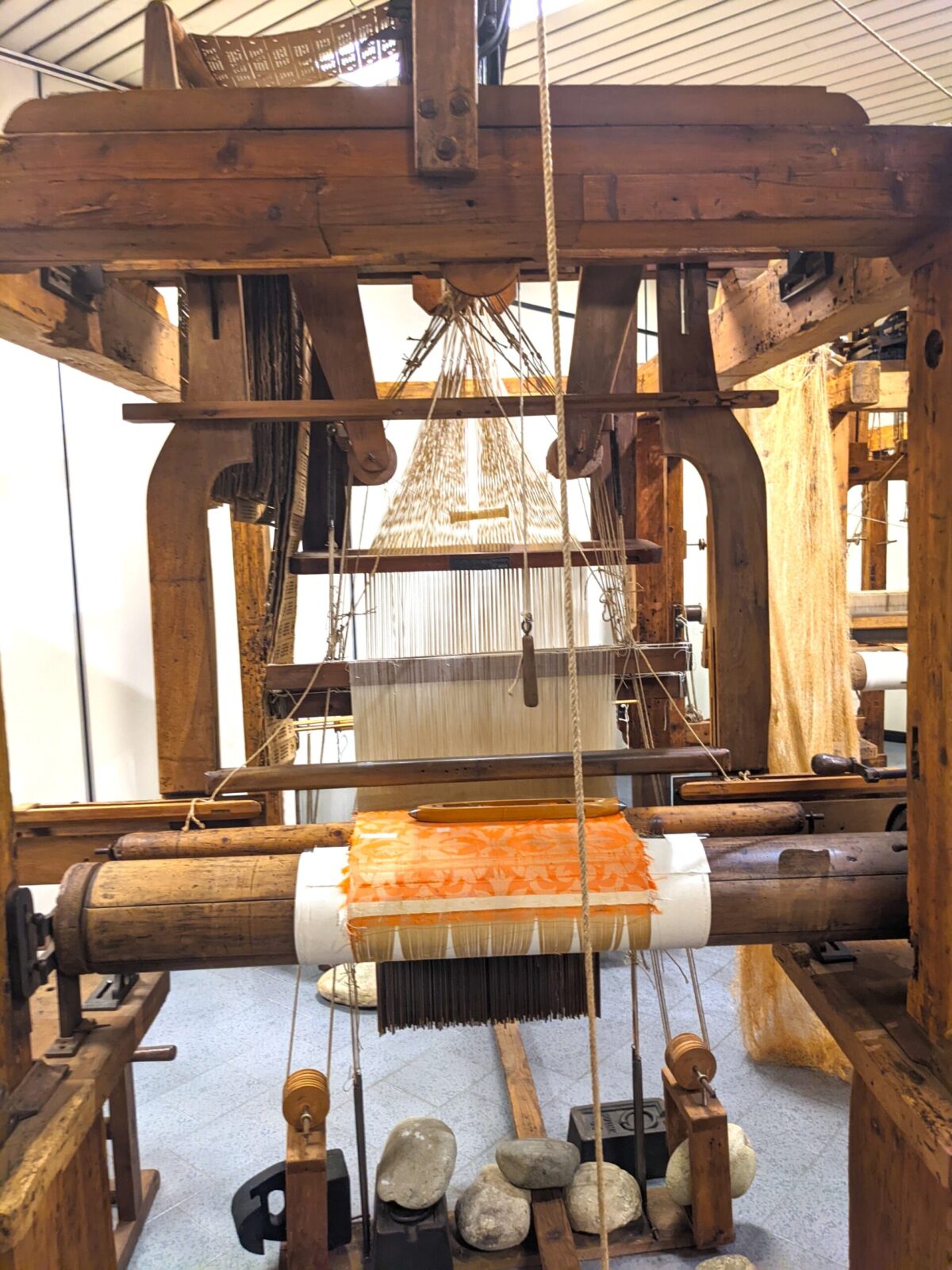
The Museum of silk in Como. Source: https://www.charlottebetts.com
Chemical geometry: Nature’s structural engineering
To understand why real silk feels, drapes, and breathes unlike any other material on the planet, you have to look past the weaver’s loom and peer straight through an electron microscope.
At its core, silk is pure liquid biology turned solid. The thread is composed of two primary proteins produced inside the silkworm’s modified salivary glands: fibroin (roughly 75–80% of the fiber), which forms the structural inner core, and sericin (20–25%), a sticky, gum-like protein that coats the twin fibroin filaments and binds them together to build the cocoon.
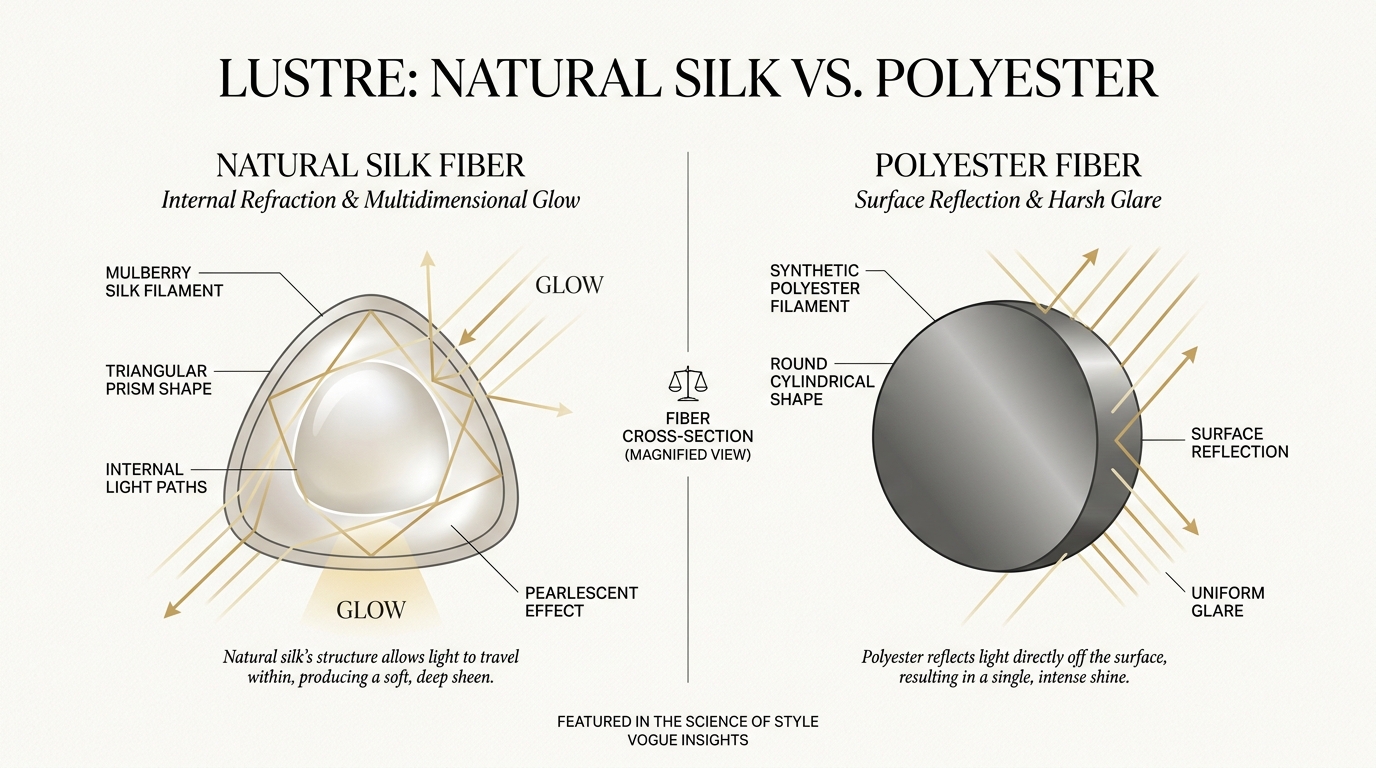
During the traditional washing process known as degumming, hot water and gentle alkaline soaps wash away the sericin armor. What remains are two shimmering, independent fibroin filaments.
And right here lies silk’s true optical secret: it is not a thread, but a microscopic triangular prism.
Most natural and synthetic fibers have round, hollow, or irregular cross-sections. Cotton looks like a collapsed, twisted ribbon; wool resembles a scaled cylinder. Silk, however, is a rounded triangle with flat, glass-smooth faces.
Beyond the Mulberry
While Bombyx mori remains the undisputed standard for commercial sericulture, the biological reality of textiles is far broader. Out of roughly 200 species across the silkworm and wild moth families, only a handful yield filaments suited for weaving. Yet throughout history, humans have continually adapted all manner of insect—and even marine—secretions into high-status fabrics.
Any silk harvested from non-domesticated species falls into the category of wild silk. Unlike the smooth filament of Bombyx mori, wild silks are defined by uneven thread diameters, natural slubs, inherent pigmentation, and complex harvesting conditions that resist easy industrial scaling.
Mediterranean luxury and the scandals of Cos
Long before Chinese Silk Road caravans reached Mediterranean ports, the ancient world produced its own local luxury textile: Cos clothing (Coa vestis). On the Greek island of Cos, weavers harvested the large cocoons of the wild cypress moth (Pachypasa otus).
Spinning these wild filaments yielded an ultra-lightweight, gossamer fabric that draped closely over the silhouette. By the 1st century BCE, Cos silk became the definitive attire of high-class Roman courtesans (meretrices) and elite women, drawing fierce backlash from Roman moralists like Ovid and Pliny for its sheer transparency. Once authentic Chinese mulberry silk—denser, stronger, and more opaque—became widely available, production on Cos gradually faded into history.
Assam’s hydrophobic phenomenon: The Gold of Muga
In the humid valleys of Assam, India, the wild moth Antheraea assamensis yields one of the most chemically remarkable fibers in existence: Muga silk. Unlike Bombyx mori filaments, which require bleaching and dyeing, raw Muga thread possesses a natural, deep amber-gold hue.
From a structural standpoint, Muga fiber is exceptionally durable and hydrophobic:
- It naturally repels liquids and oily stains, making the woven textile nearly impossible to discolor.
- It resists mechanical wear: rather than degrading, every wash tightens its protein alignment, causing the natural metallic sheen to intensify over time.
- Muga garments are traditionally passed down through generations for centuries without losing structural integrity or color depth.
Oak moths and industrial shantung
To produce heavier, highly textured fabrics, textile makers turned to the Chinese oak silkworm (Antheraea pernyi). Because the larvae feed on oak leaves, the resulting protein filament contains high concentrations of tannins, giving raw threads a warm, sandy-beige tone.
This fiber is woven into shantung (historically known in Eastern Europe as chesoocha or чесуча). It is a crisp, medium-to-heavyweight plain-weave fabric recognized by its irregular slubs (knots) and tactile, matte finish. Throughout the 20th century, oak silkworms were cultivated extensively across Eurasia to produce rugged outerwear, tailored suiting, and industrial utility silks where flawless smoothness was secondary to durability.
Byssus: textile gold from the seabed
The most extraordinary biological protein in textile history comes not from an insect, but from the seabed. Sea silk (byssus) is produced by the noble pen shell (Pinna nobilis), a giant Mediterranean clam that anchors itself to underwater rocks by secreting strong, silk-like anchor threads.
- Acid-Induced transformation: Raw harvested byssus has a dull olive-brown tone. However, when treated with a mild citric acid bath (traditionally lemon juice), an irreversible chemical reaction occurs: the protein turns into an iridescent, non-fading metallic gold.
- Physical properties: Byssus fiber is lighter than feather down, highly thermal-retentive, and exceptionally strong. Ancient lore measured its fineness by demonstrating that a pair of byssus gloves could be crumpled tightly enough to fit inside a walnut shell.
Due to the extreme labor required to harvest byssus underwater – it takes dozens of clam pods to yield a single gram of fiber – sea silk appears in ancient Egyptian records and biblical texts as a material reserved exclusively for pharaohs, high priests, and monarchs.
Today, Pinna nobilis is a strictly protected species, leaving the ancient craft in the hands of its last living guardian: Chiara Vigo. Living on the Sardinian island of Sant’Antioco, the master artisan, who half-jokingly refers to herself as an “old witch” due to the ritualistic, secretive nature of her craft is the sole keeper of the tradition. Adhering to a strict ancient oath, Vigo refuses to sell her creations for money, famously declaring that the sea silk cannot be bought. Instead, she gifts her masterpieces exclusively to museums, international dignitaries, newlyweds, and mothers struggling with fertility, ensuring that textile gold remains a sacred gift of nature rather than a luxury commodity.
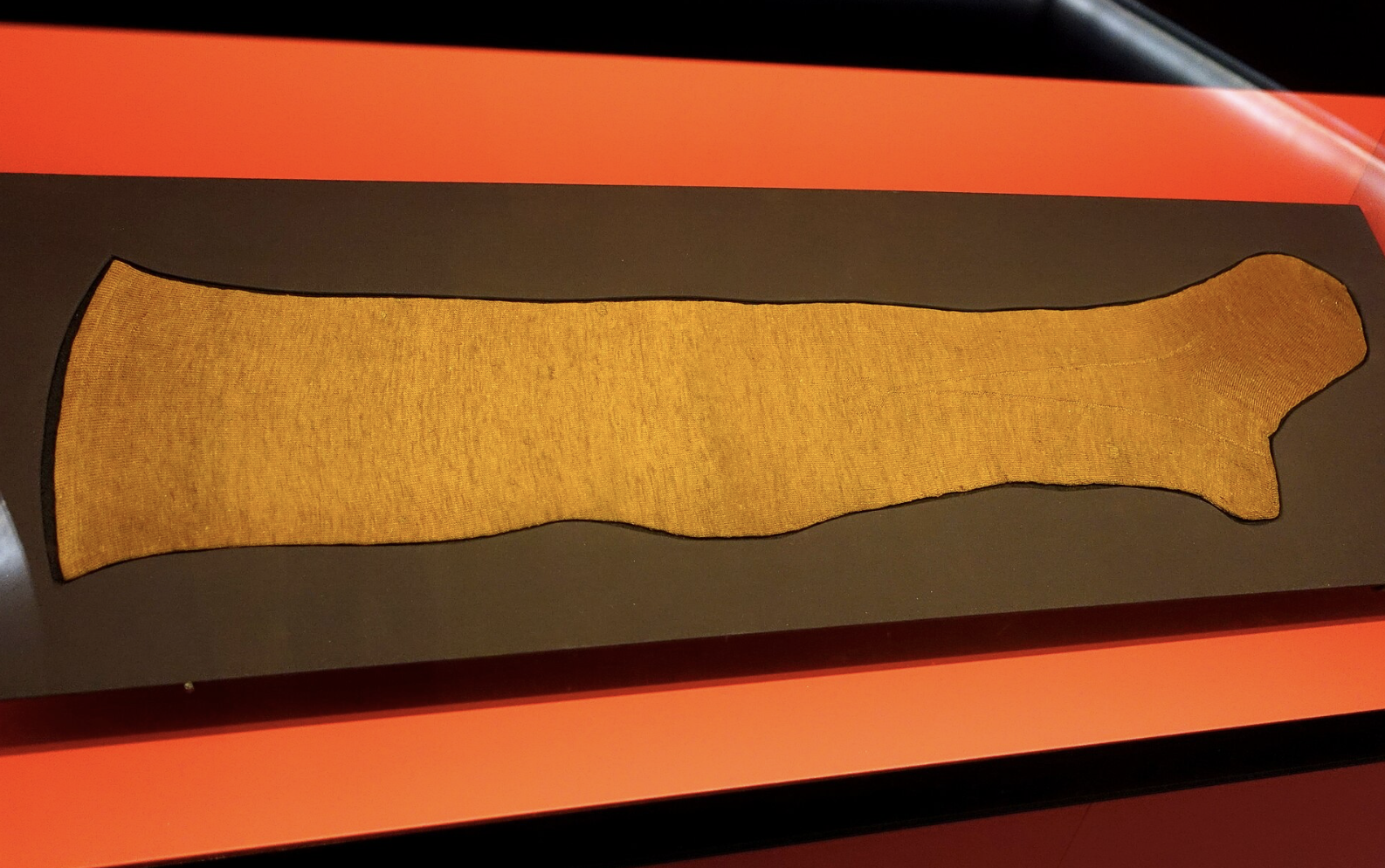
Stocking made of sea silk (byssus) from Pinna nobilis, 1765-1800 AD – Naturhistorisches Museum, Braunschweig, Germany
Silk vs. Polyester
When synthetic satin was introduced as a cheap alternative to silk, it promised the same glossy finish at a fraction of the cost. But while a photograph might occasionally fool the eye, the skin immediately knows the difference. The contrast comes down to a fundamental clash between biological structure and petroleum chemistry. Let’s look closer at the differences.
1. The fiber shape
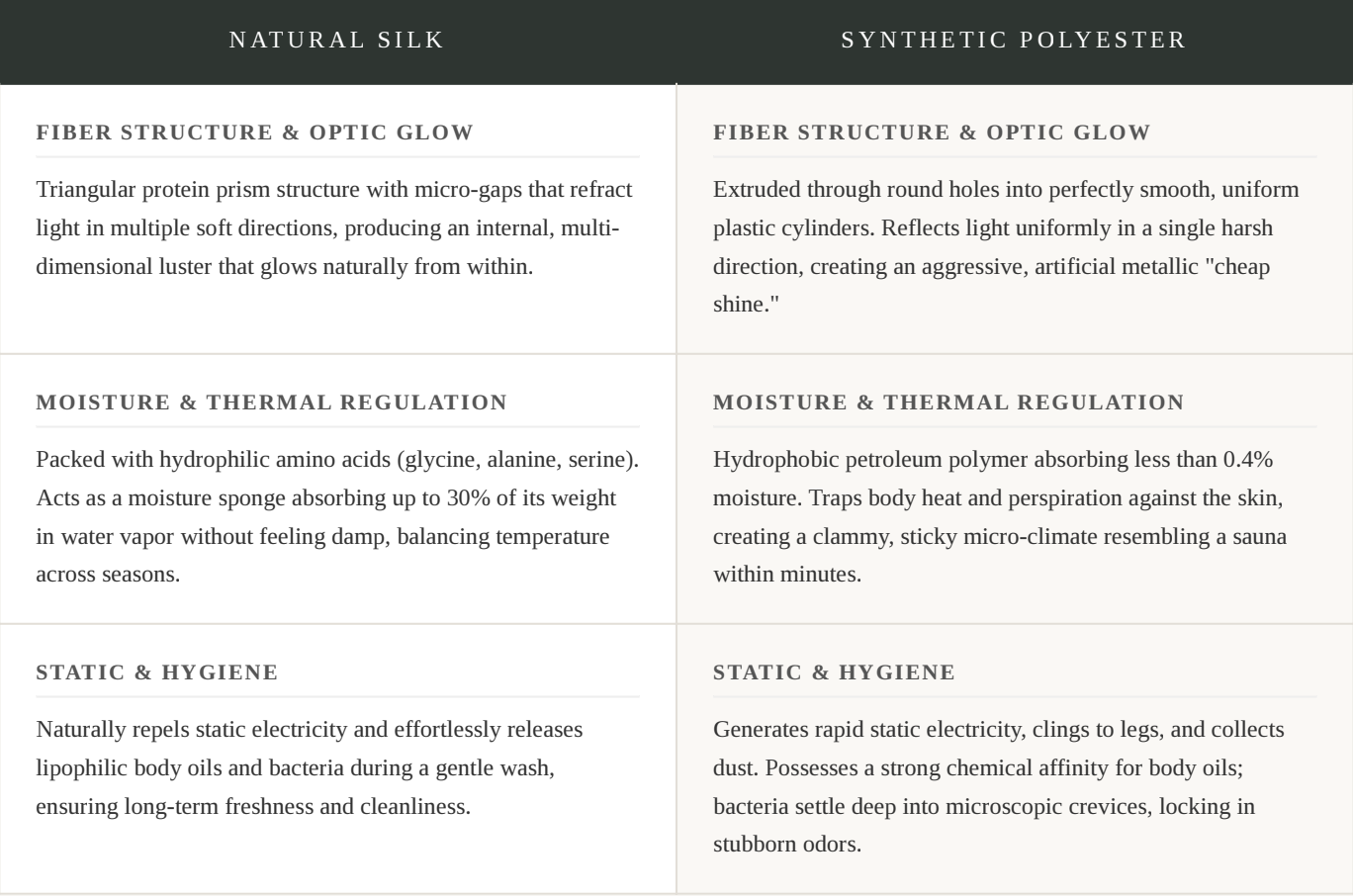
Polyester is extruded by forcing melted plastic through tiny round showerhead holes. The resulting fiber is a perfectly smooth, uniform plastic cylinder. Because the surface is flat and non-porous, light bounces straight off the exterior in a single, aggressive direction. That is why synthetic satin often has a harsh, metallic “cheap shine” that flattens out under direct light, while real silk glows from within.
2. Moisture absorption
Silk proteins are packed with hydrophilic (water-loving) amino acids like glycine, alanine, and serine. This microscopic network acts as a moisture sponge, absorbing up to 30% of its own weight in water vapor without ever feeling damp to the touch. It draws sweat away from the skin and lets it evaporate into the air, keeping you cool in summer and locking in ambient heat during winter. Cool, isn’t it?
Polyester, on the other hand, is a hydrophobic plastic polymer. It absorbs less than 0.4% moisture. When you wear synthetic satin, your body heat and perspiration get trapped between your skin and a wall of plastic. The result is that clammy, sticky micro-climate that makes cheap eveningwear feel like a sauna only after twenty minutes.
3. Static
Because polyester cannot hold moisture, it generates rapid static electricity. It clings to legs, collects dust, and sparks in dry air. Furthermore, petroleum-based fibers have a natural chemical affinity for lipophilic (in other words fat-based) body oils. Once bacteria settle into the microscopic crevices of a polyester thread, the trapped body odor becomes notoriously hard to wash out even at high temperatures. Silk naturally repels static and releases oils effortlessly during a gentle wash.
Eco-silk & “Vegan silk” or Exposing the greenwashing myth
In recent years, marketing campaigns have flooded the fashion world with terms like “vegan silk,” “silk touch,” “eco-satin,” and “bamboo silk.” While presented as ethical, eco-friendly modern upgrades, scratching beneath the surface reveals a very different chemical reality.
The plastic “vegan” trap
The vast majority of garments labeled as “vegan silk” are simply 100% polyester or polyurethane wrapped in clever storytelling. While it is true that no silkworms are harmed, substituting a renewable, fully biodegradable biological protein with a fossil-fuel-derived plastic is an environmental disaster. Every time a synthetic garment is washed, it sheds thousands of microscopic plastic fibers (microplastics) that bypass municipal filtration systems and end up in the oceans. A synthetic “vegan silk” blouse will sit in a landfill for 200 to 500 years. A pure silk garment buried in soil decomposes naturally within a few months, returning organic nitrogen to the earth.
The viscose Illusion
Other alternatives like Art silk or Bamboo silk are regenerated cellulose fibers (viscose or modal). While they start from plant matter like wood pulp or bamboo stalks, transforming tough plant cellulose into a silky fiber requires an intense chemical bath of carbon disulfide, caustic soda, and sulfuric acid. Unless produced in a closed-loop system (like certified Tencel: trade mark for Lyocell fiber), the runoff from traditional viscose production severely pollutes local waterways and surrounding ecosystems.
While plant-based regenerated fibers offer better breathability than plastic polyester, they lack silk’s natural tensile strength—especially when wet—and deteriorate far faster over washing cycles.
How to test and identify true silk
When sourcing fabrics or verifying high-end inventory, relying solely on woven tags isn’t always enough. Fortunately, the fundamental chemical differences between protein fibers, plant cellulose, and petroleum plastics make identification straightforward if you know what to look for.
1. The burn test
If you can pull a single loose thread from a seam or selvage, hold it with tweezers and bring a lighter flame to the tip:
- Real Silk: It burns slowly and cautiously. It immediately curls away from the flame and self-extinguishes the moment the fire source is removed. It smells distinctly like burnt hair or feathers (due to the sulfur in protein amino acids). The remaining residue is a soft, dark, irregular ash that easily crushes into a fine powder between your fingertips.
- Polyester: It melts instantly before the flame even touches it, dripping and burning with a dark, smoky flame. It smells like sweet, chemical plastic. Instead of ash, it cools into a hard, uncrushable plastic bead that will cut or puncture paper.
- Viscose / Rayon: It catches fire rapidly and burns with a bright, steady yellow flame. It smells like burning paper or autumn leaves. It leaves behind a tiny wispy light-gray ash with no hard bead and no self-extinguishing behavior.
2. The temperature test
Hold the fabric against your cheek. Real silk immediately absorbs your body temperature, feeling soft, neutral, and warm almost instantly. Polyester feels cold initially and stays non-responsive, then abruptly traps heat once your skin starts to warm the air layer beneath it.
Next, rub the fabric briskly between your palms. Real silk generates a soft, quiet, rustling sound—historically known as the scroop of silk—and warms up rapidly due to internal fiber friction. Synthetic satin produces a slick, silent slide or a high-pitched synthetic squeak without generating natural warmth.
3. The touch test
Real silk has a subtle, microscopic unevenness woven into its soul. Because it is a natural filament spun by a living creature, a thread of real silk exhibits tiny, almost invisible variations in thickness along its length. Polyester, extruded by machine precision, is unnaturally flawless and uniform.
When draped over a hand, authentic Italian-finished silk yields a heavy, liquid drop that follows gravity smoothly, whereas lightweight synthetic fabrics flutter stiffly or cling to skin via static charge.
With the right fabric, your vision transforms from a concept into a masterpiece. At our textile sourcing agency, we connect visionary designers and luxury brands with the world’s most exceptional materials, offering direct access to premium Italian silks, rare natural fibers, and meticulously vetted deadstock. Whether you are developing an upcoming collection or hunting for that elusive, perfect drape, let us source the extraordinary for you.
Get in touch with our team today to explore our exclusive textile catalog or request custom swatches or take a moment to explore our silk collection in our catalogue!